

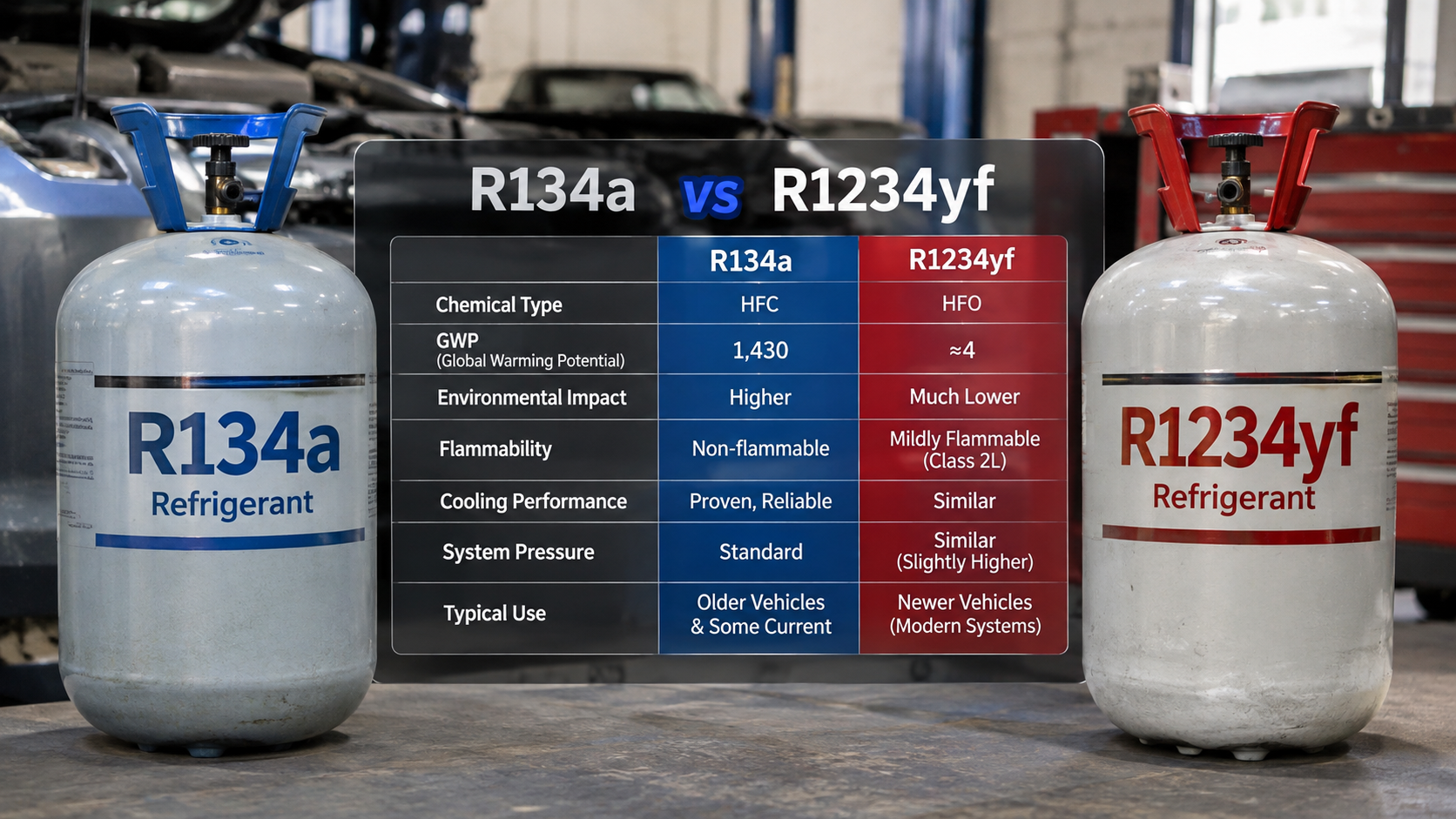
Bought a newer car and noticed your workshop asking which refrigerant it uses? The R1234yf vs R134a question matters more than most drivers think. These are the two refrigerants you’ll find in car aircon systems on Singapore roads today, and they are not interchangeable. Using the wrong one, or mixing them, can cost you cooling performance and even damage parts. In this guide, we at MrKool explain how to tell which refrigerant your car uses, how the two differ, and what it means for servicing in our hot, humid climate.
R1234yf vs R134a: The Quick Difference
Both refrigerants do the same job. They circulate through your aircon system, absorb heat from the cabin at the evaporator (cooling coil) and release it at the condenser in front of the radiator. The differences are in their chemistry, the equipment needed to handle them, and which cars use them.
- R134a has been the standard car aircon refrigerant for decades. Most older cars, and many cars still on the road in Singapore, run on R134a.
- R1234yf is the newer refrigerant adopted by many carmakers for recent models. It was introduced mainly because it has a far lower global warming potential than R134a.
- Mild flammability: R1234yf is classed as mildly flammable, so it needs proper equipment and trained handling. Systems built for it include design features that account for this.
- Different fittings: The service ports on R1234yf systems are a different size from R134a ports. This is deliberate, so the two are not accidentally mixed.
- Different service machines: A workshop needs dedicated recovery and recharging equipment for each refrigerant. A machine for R134a should not be used on an R1234yf system, and vice versa.
In daily driving, you won’t feel much difference between the two when the system is healthy. Both can keep your cabin cool in Singapore’s afternoon heat. The difference shows up when the system needs servicing.
How to Tell Which Refrigerant Your Car Uses
You don’t need to guess. Here are the easiest ways to check:
- Look for the sticker under the bonnet. Most cars have a label near the front of the engine bay, often on the bonnet slam panel or radiator support. It states the refrigerant type (R134a or R1234yf, sometimes written HFO-1234yf) and the charge amount.
- Check the owner’s manual. The specifications section usually lists the aircon refrigerant and its quantity.
- Look at the service ports. If you’re comfortable opening the bonnet, the low and high pressure port caps may be marked. R1234yf ports look different from R134a ones.
- Ask your workshop. A proper car aircon workshop can confirm the refrigerant type during inspection.
As a rough guide, newer models are more likely to use R1234yf, while older cars typically use R134a. But model year alone isn’t reliable, because carmakers switched at different times. Always confirm with the label.
Why It Matters for Your Car Aircon
You can’t mix or swap them
Topping up an R1234yf system with R134a, or the other way round, contaminates the refrigerant. Contaminated refrigerant can reduce cooling, upset system pressures and make future servicing harder, because the mixed gas has to be recovered and the system cleaned properly. The compressor oil specified for each system also differs, so the wrong refrigerant can come with the wrong oil.
DIY top-up cans are risky
Off-the-shelf top-up cans may not match your car’s refrigerant, and some contain sealants or additives. These can clog small passages in the expansion valve or condenser and contaminate workshop equipment. If your aircon is losing cold, it’s usually a sign of a leak or another fault, not just “low gas”. You can read more in our guide on car aircon gas top up in Singapore.
The correct charge amount matters
Every system is designed for a specific amount of refrigerant. Too little and the aircon won’t cool well. Too much and pressures run high, which strains the compressor. Proper recovery, vacuum and recharge to the specified amount is the right way to do it.
Practical Tips for Owners
- Note your refrigerant type from the bonnet sticker and keep it with your servicing records.
- Tell your workshop upfront, especially if you drive a newer car, so they can prepare the right equipment.
- Avoid unknown top-ups. Ask what refrigerant and how much is being added to your car.
- Don’t ignore weak cooling. If your aircon is getting warmer, see our article on why your car aircon is not cold for common causes.
- Keep up with maintenance. A clean cabin filter and cooling coil help either refrigerant work efficiently. Learn more about car aircon filter replacement.
Signs You Need a Professional
Whichever refrigerant your car uses, get it checked if you notice:
- The aircon blows cool but not cold, especially when stuck in traffic
- Cooling drops off within weeks of a previous top-up
- Hissing sounds, or oily residue around aircon pipes and joints
- The compressor clicks on and off frequently
- You’re not sure what refrigerant was put in during a past service
These signs often point to a leak, contamination or a component problem that needs proper diagnosis rather than another top-up.
How MrKool Helps
At MrKool, we focus on car aircon only, and we handle both R134a and R1234yf systems. We start by confirming your car’s refrigerant type and checking the system before recommending any work. Exact pricing is confirmed after inspection.
- K11HV system recovery (from $80): Recovers the refrigerant from your system using proper equipment, so it can be recharged to the correct amount.
- K11HV system flushing (from $108): Flushes the system to clear contaminants, useful when the wrong refrigerant or a sealant may have been added.
- Cooling coil external flushing bundle (from $188): Cleans the evaporator to restore airflow and reduce odours.
- Signature aircon care bundle (from $288): Our most complete care package, adding condenser cleaning, blower fan cleaning and air duct steaming.
See what each service covers on our car aircon service and maintenance page. If your compressor has been strained by the wrong charge or contamination, we also offer car aircon compressor replacement.
Where to Find Us
Our flagship is MrKool @ Carros Centre, 60 Jalan Lam Huat, #05-54, Singapore 737869. You can also visit our authorised Motoserv service centres at Bukit Panjang, Bukit Batok, Toa Payoh, Bukit Merah, Upper Thomson, Boon Lay, Serangoon Garden and Havelock, for 9 locations across Singapore.
FAQs
Can I put R134a into a car designed for R1234yf? No. The systems use different fittings, oils and equipment. Mixing refrigerants causes contamination and can affect cooling and components.
Is R1234yf better at cooling than R134a? In a healthy system designed for it, each refrigerant cools well. What matters most is that your car has the correct refrigerant at the correct charge.
Is R1234yf safe in my car? Yes. Cars built for R1234yf are designed with its properties in mind. It’s mildly flammable, which is why servicing should be done by a workshop with the right equipment.
Why might servicing an R1234yf car cost more? It needs dedicated equipment and the refrigerant itself is typically more expensive. We confirm the exact price after inspecting your car.
How do I know what refrigerant my car uses? Check the sticker under the bonnet or your owner’s manual. Our team can also confirm it during inspection.
Book Your Car Aircon Check
Not sure whether your car runs on R1234yf or R134a, or worried about a past top-up? Let us take a look. WhatsApp or call us at +65 8118 1648, or book your appointment online. We’ll confirm your refrigerant type, check your system and recommend only what your car needs.