

Your aircon is blowing, but the air feels weak, smells a bit stale, or your windscreen takes forever to clear on a rainy morning. Before you assume the worst, check the simplest part of the system: the cabin air filter. A car cabin air filter replacement is one of the cheapest and quickest jobs on any car, yet it is also one of the most often forgotten. In this guide, we explain what the filter does, how often to change it in Singapore conditions, whether you should DIY or go to a workshop, and when a dirty filter is a sign of a bigger aircon problem.
What Does a Cabin Air Filter Actually Do?
Every bit of air that comes out of your aircon vents first passes through the cabin air filter. It usually sits behind the glovebox or under the dashboard on the passenger side, just before the blower fan and the cooling coil (evaporator).
Its job is to trap:
- Dust and road grime from busy expressways
- Pollen, leaves and small debris
- Fine particles from exhaust fumes and, during haze periods, smoke
- Moisture-loving dirt that would otherwise coat your cooling coil
When the filter is clean, air flows freely and your cooling coil stays cleaner for longer. When it is clogged, everything downstream works harder.
Car Cabin Air Filter Replacement: How Often in Singapore?
Your owner’s manual is the best starting point, as recommended intervals differ between makes and models. Many carmakers suggest checking or replacing the filter at each routine service, which for most drivers works out to roughly once a year.
In Singapore, though, a few local factors mean many cars need it sooner:
- Heat and humidity all year round. Damp air plus trapped dust is an ideal environment for mould and bacteria on the filter.
- Heavy stop-start traffic. More exhaust particles get pulled into the system.
- Haze periods. When regional haze hits, filters load up with fine particles much faster.
- The northeast monsoon. The rainy months from around November bring more moisture into the system, so a filter that was “okay” in the dry months can start to smell musty.
- High-mileage use. Private-hire, delivery and family cars that clock long daily hours will clog filters faster than a weekend car.
If you drive a lot, park outdoors under trees, or often have young kids or elderly passengers on board, it is worth checking the filter more often, around every six months.
Signs Your Cabin Filter Needs Changing
You don’t need to wait for the service reminder. Look out for these:
- Weak airflow even with the fan on high
- Musty, sour or “wet sock” smell when you first switch on the aircon
- Windscreen fogging that takes longer than usual to clear
- More dust on the dashboard shortly after cleaning
- Sneezing or itchy eyes in the car, especially for passengers with sensitivities
- Whistling or louder fan noise as the blower struggles to pull air through
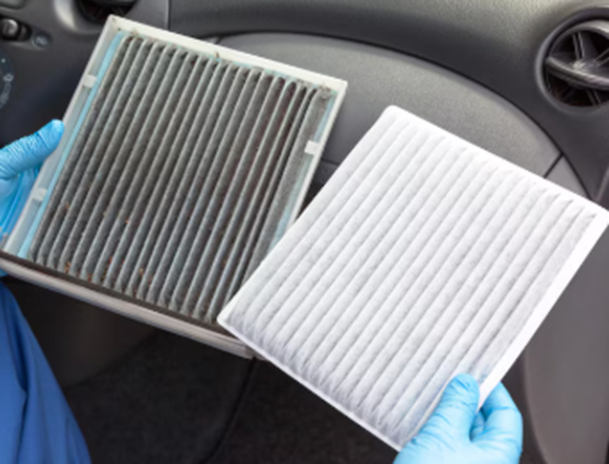
If you pull the filter out and it is grey or black, packed with leaves or showing dark spots, it is overdue.
DIY vs Workshop: Which Is Better?
DIY replacement
On many cars, a cabin air filter replacement is a simple job: empty the glovebox, unclip it, slide out the old filter and slide in a new one with the airflow arrow pointing the right way.
DIY makes sense if:
- Your filter is easy to reach behind the glovebox
- You are confident buying the correct filter size for your model
- You only want to swap the filter and nothing else
Common DIY mistakes include fitting the filter against the airflow arrow, buying one that doesn’t seal properly, and spraying deodoriser into the vents to mask a smell.
Workshop replacement
Some cars hide the filter under the dashboard or behind trim panels, which makes DIY fiddly. More importantly, a workshop can look at what the dirty filter is telling you.
If your old filter is badly clogged or mouldy, chances are the blower fan, air ducts and cooling coil behind it have collected dirt too. Swapping only the filter will improve things, but the smell or weak airflow may come back quickly. A technician can check the whole airflow path and advise whether cleaning is needed.
When a Dirty Filter Points to a Bigger Problem
A new filter fixes airflow and freshness issues caused by the filter itself. It won’t fix:
- Aircon not cold enough. This is usually about refrigerant, the compressor or the condenser. See our guide on car aircon not cold in Singapore.
- A persistent musty smell after replacement. Mould has likely built up on the cooling coil and in the ducts. Our article on musty smells and windscreen fogging explains why.
- Water dripping inside the car. Often a blocked drain line, not the filter.
- Clicking or grinding noises. These usually come from the blower motor or compressor.
If your car shows any of these alongside a dirty filter, it is time to bring it to a professional.
How MrKool Helps
At MrKool, we focus only on car aircon, so cabin air quality is a core part of what we do. Our technicians can replace your cabin filter and check whether the rest of the airflow path needs attention. Learn more on our car aircon filter replacement page.
If the filter was very dirty, these packages may be worth considering (all prices are “from”, with the exact price confirmed after inspection):
- Cooling coil external flushing bundle, from $188. Cleans the cooling coil, where mould and odours tend to build up behind a dirty filter.
- Signature aircon care bundle, from $288. Adds condenser cleaning, blower fan cleaning and air duct steaming for a more thorough refresh of the whole system.
For regular upkeep, see our car aircon service and maintenance page. We work on both R134a and R1234yf systems, so whatever your car uses, we can handle the full aircon check, not just the filter.
Where to Find Us
Our flagship workshop is MrKool @ Carros Centre, 60 Jalan Lam Huat, #05-54, Singapore 737869.
You can also visit our authorised Motoserv service centres in Bukit Panjang, Bukit Batok, Toa Payoh, Bukit Merah, Upper Thomson, Boon Lay, Serangoon Garden and Havelock, giving you 9 locations across Singapore.
FAQs
How often should I replace my car cabin air filter in Singapore? Follow your owner’s manual, which for many cars means at each service, roughly once a year. If you drive long hours, park outdoors or drive through haze often, check it every six months.
Can a dirty cabin filter make my aircon less cold? It can make the airflow weaker, so the cabin feels warmer and cools down more slowly. If the air itself isn’t cold, the cause is usually elsewhere in the aircon system.
Is a carbon cabin filter worth it? A carbon filter adds an odour-absorbing layer, which many drivers find helpful in heavy traffic or during haze. Make sure it is the correct fit for your car so it seals properly.
Will replacing the filter get rid of a musty smell? Sometimes, if the smell came from the filter. If it returns quickly, mould has likely built up on the cooling coil or in the ducts, which needs cleaning.
Can I clean and reuse my cabin filter? Most cabin filters are designed to be replaced, not washed. Tapping out loose dust is only a short-term measure, and washing can damage the filter material.
Book Your Cabin Filter Check Today
Fresh air in your car shouldn’t be an afterthought, especially with the rainy season here. WhatsApp or call us at +65 8118 1648, or book an appointment online. We’ll check your cabin filter and let you know honestly whether a simple replacement is all you need.